

GREEN FROG REVOLUTION
Our integrated engineering platform
Green Frog Revolution has developed an integrated engineering platform for the controlled treatment, recovery, and productive reuse of mixed and contaminated plastic waste.
Engineering Difficult Plastic Waste Into Lasting Value
Green Frog Revolution (GFR) is developing an integrated engineering platform for the controlled treatment, recovery, and productive reuse of mixed and contaminated plastic waste.
Rather than relying on a single process, GFR brings together controlled thermal treatment, process-gas management, CSET combustion technology, material consolidation, environmental monitoring, and product manufacture within one engineering system.
The objective is simple: recover useful value from difficult waste while measuring and controlling what happens to the material throughout the process.
Technical Research & Publication
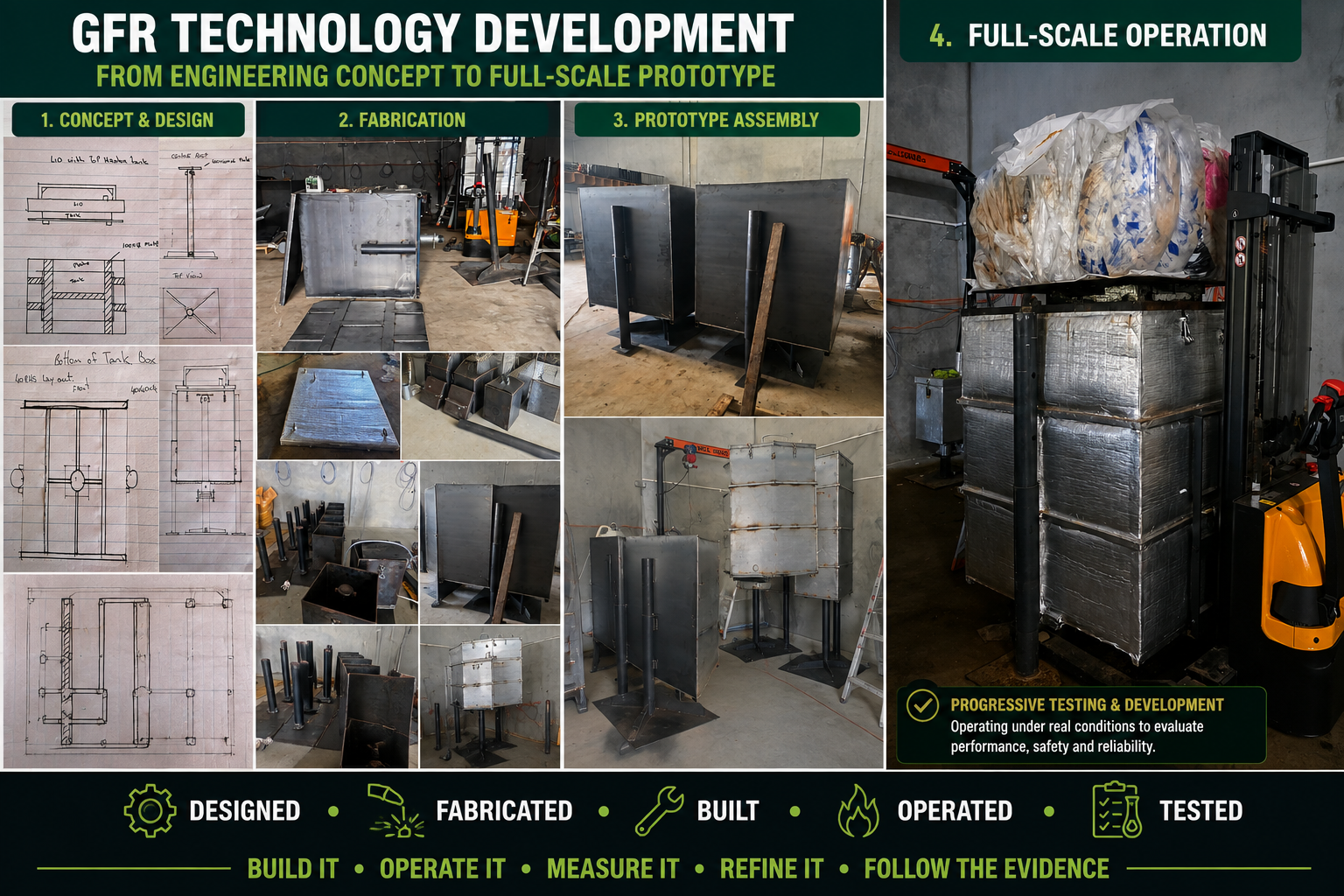
GFR’s engineering development is supported by documented reactor trials and technical research.
Public Research Preprint
Brett Jason Head’s manuscript, “Integrated processing of heterogeneous waste plastics through controlled thermal consolidation and contaminant management,” is publicly available on Research Square.
The preprint presents research on the integrated processing platform. It has not been certified by peer review.
Thermal Consolidation Manuscript
A manuscript documenting full-scale thermal consolidation trials and reduced preprocessing has been submitted to Discover Sustainability for consideration.
This research examines processing observations and the development of consolidated material for subsequent cutting and product evaluation. Journal submission does not constitute acceptance or completed peer review.
Further Investigations
Supplemental-fuel utilisation, emissions performance and PFAS treatment are being investigated separately. Initial independent PFAS chemical testing confirmed mineralisation under the tested operating conditions. Further testing is required to assess repeatability, operating parameters and overall emissions performance
Intellectual Property & Technology Development
The intellectual property underpinning the GFR platform is held by Vapour Draw Systems Pty Ltd. The development program combines patent applications, practical reactor engineering and operational know-how.
CSET Technology
Australian Standard Patent Application No. 2026200930
A Combustion Support and Exhaust Treatment Module, System and Method
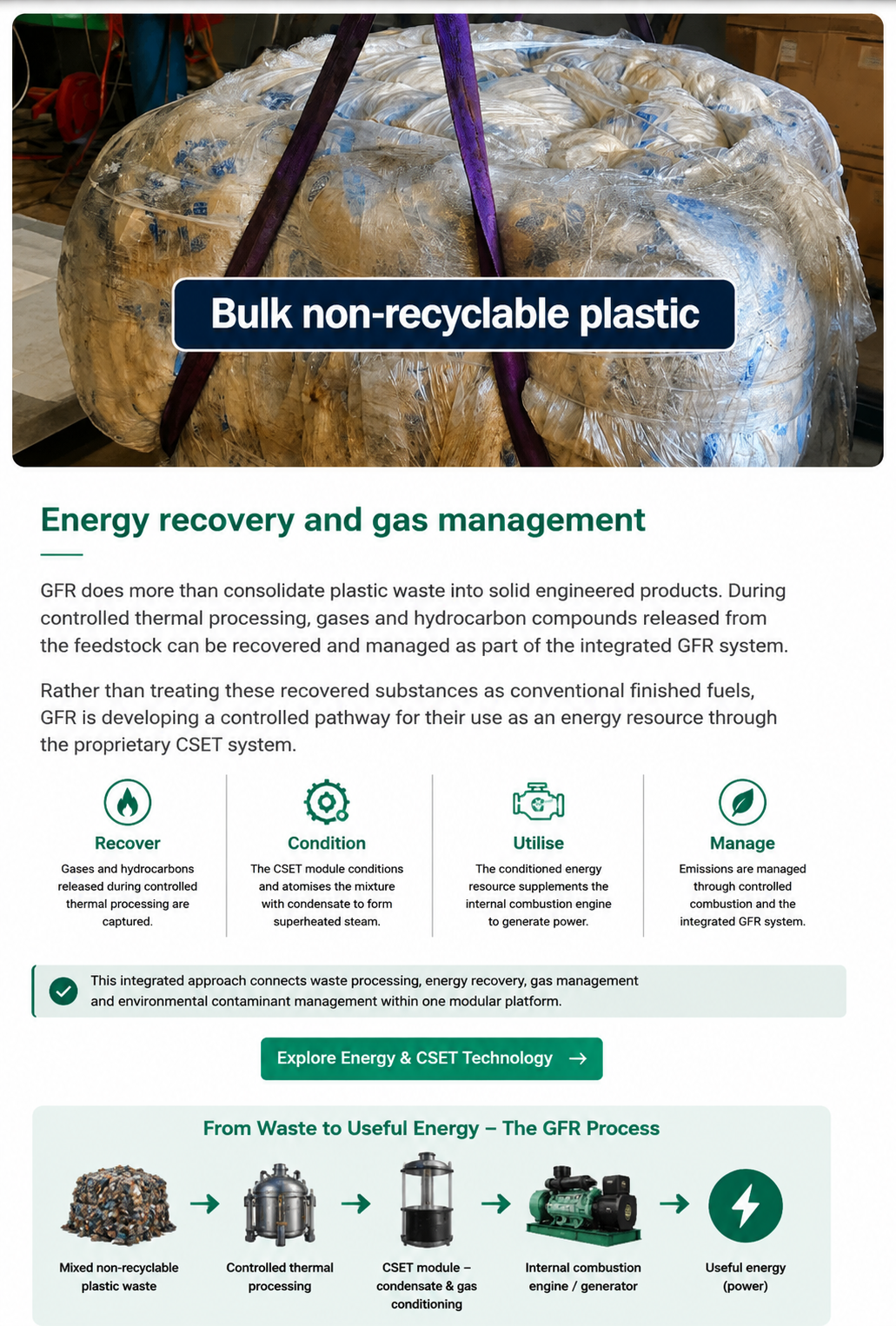
This application concerns the CSET module and associated systems for combustion support and exhaust treatment. Within the integrated GFR platform, CSET conditions extracted process gases and condensate for introduction into a host internal combustion engine, where recovered hydrocarbons provide supplemental fuel.
Reactor Technology
A Vacuum Pyrolysis System
A separate patent application concerns vacuum pyrolysis reactor technology and associated system architecture.
GFR’s current thermal consolidation trials focus on recovering solid material.
Supporting Industrial Deployment
GFR’s proposed commercial model uses the technology to deliver long-term industrial waste-processing services, supported by equipment maintenance and technical development.
Commercial use of the intellectual property will be governed by the applicable ownership and licensing arrangements.
The applications listed here are presented as patent applications. Technical performance is assessed separately through engineering trials and independent testing.
How Reactor Gases Are Treated and Used to Generate Energy Through the CSET module system
The Combustion Support and Exhaust Treatment (CSET) system conditions reactor gases before combustion and treats the exhaust gases afterwards.
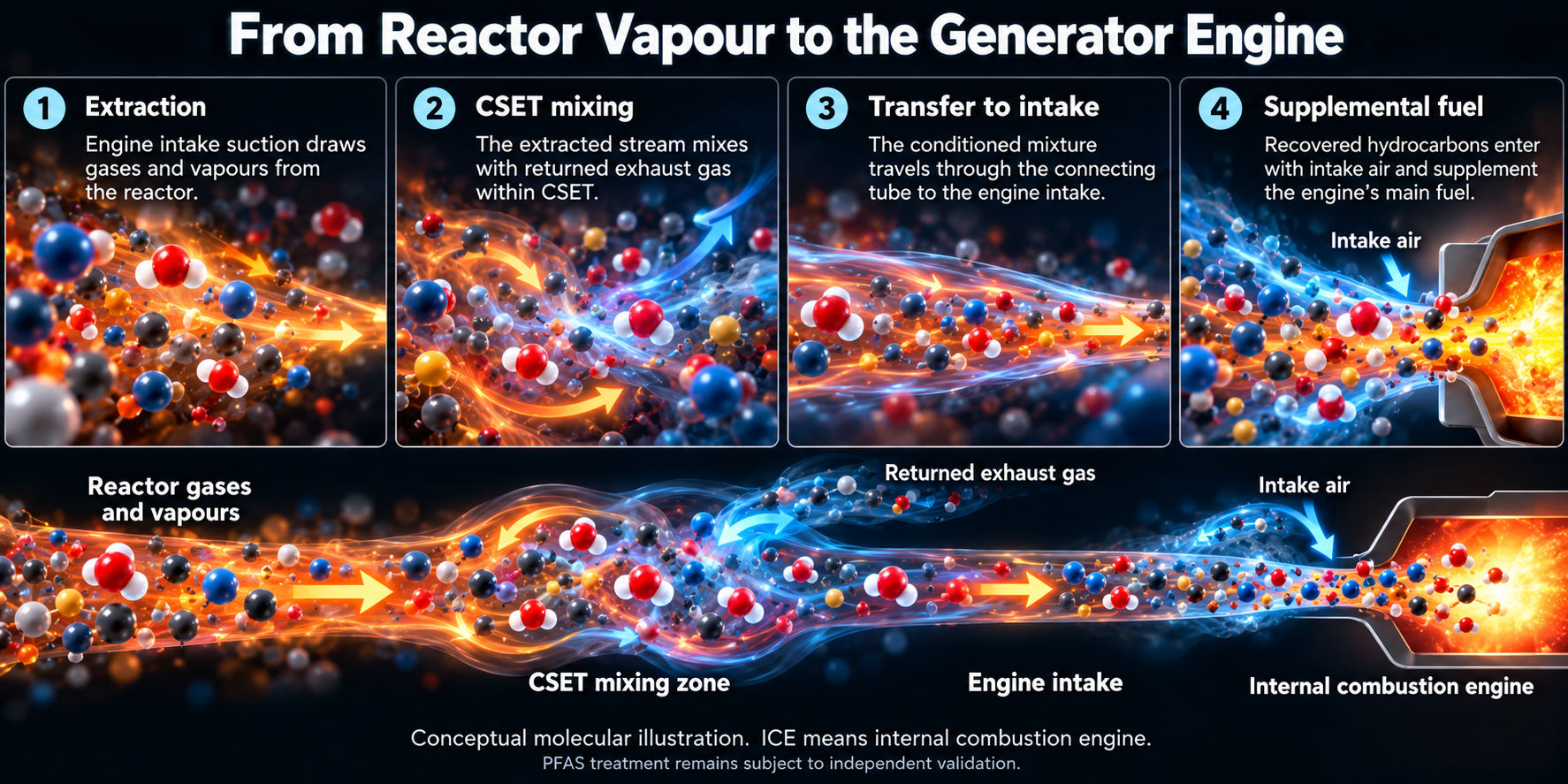
- Gases and vapours released within the sealed reactor are drawn through the pre-combustion CSET module by the internal-combustion engine’s air intake.
- Within the pre-combustion CSET, condensable constituents are collected and the remaining gaseous vapour mixture is conditioned before entering the engine’s intake-air charge.
- The conditioned mixture may contain water vapour and combustible or combustion-supporting constituents that supplement combustion within the engine.
- The generator converts the engine’s mechanical output into electrical energy used to support the reactor process.
- Following combustion, the engine’s complete exhaust-gas stream is directed through the post-combustion CSET module.
- Within the post-combustion CSET, the exhaust stream is cooled and constituents are captured in condensate collected from the exhaust gas.
- After post-combustion treatment, the remaining gas stream may be either safely discharged, subject to verified emissions compliance, or returned to the engine’s intake-air charge for further treatment.
PFAS CHEMICAL TESTING
PROPOSED PFAS MINERALISATION PATHWAY
- The pre-combustion and post-combustion CSET modules operate together as an integrated gas-conditioning and treatment system.
- The pre-combustion CSET conditions reactor-derived gases and prepares a gaseous-vapour mixture in which PFAS-containing constituents are suspended or entrained with condensate-derived water vapour and steam.
- The prepared mixture is delivered to the combustion source, where it is exposed to the high-temperature combustion environment.
- Following combustion, the complete exhaust-gas stream passes through the post-combustion CSET.
- The post-combustion CSET cools and conditions the exhaust stream, collects condensate and captures remaining constituents.
- Treated gases may then be discharged or returned to the engine’s intake-air charge, where they pass through the combustion environment again.
- The process does not rely solely on combustion temperature or the short exposure time within an internal-combustion engine. It relies on the preparation, treatment and circulation of the PFAS-containing gaseous-vapour mixture through the pre-CSET, combustion source and post-CSET.
- PFAS mineralisation occurs within the combustion source, while both CSET modules perform essential preparation, conditioning, capture and circulation functions.
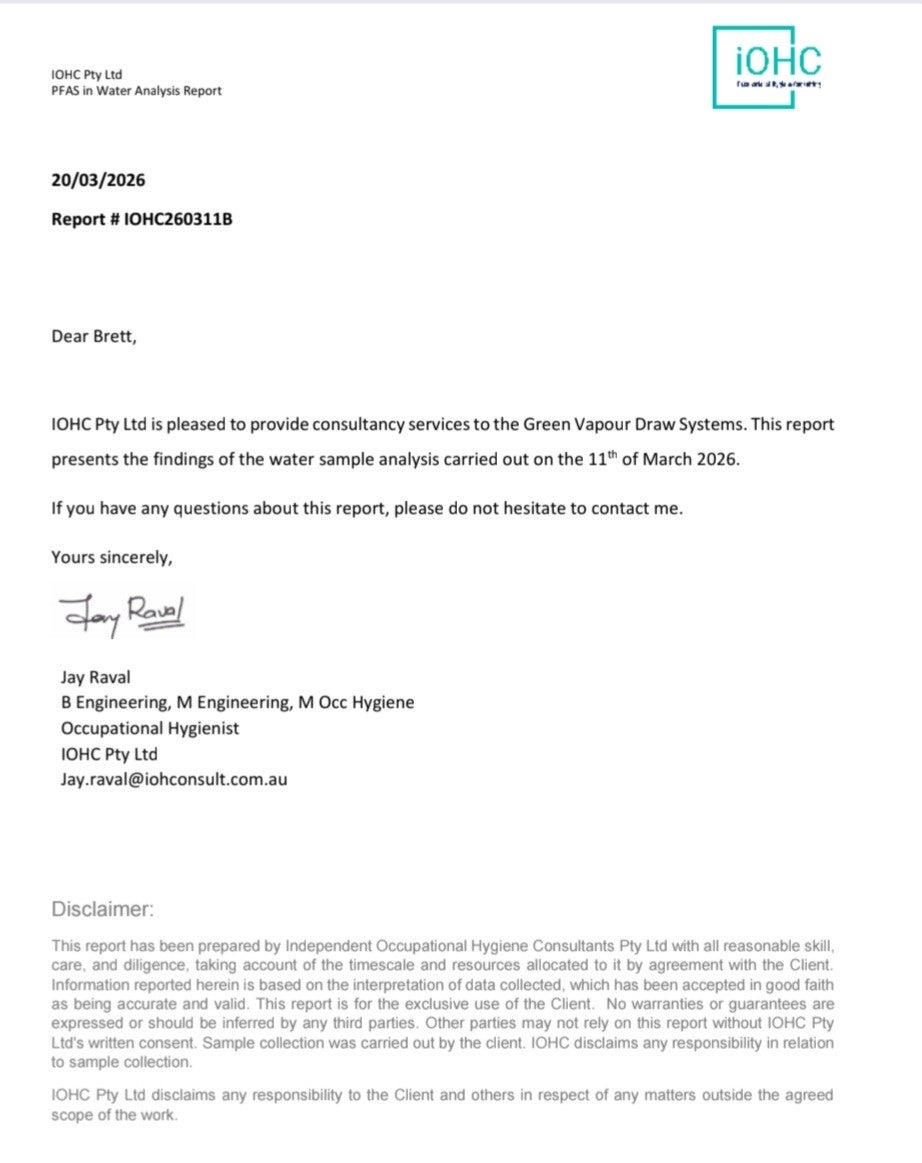
- Independent PFAS chemical testing confirmed mineralisation under the tested operating conditions.
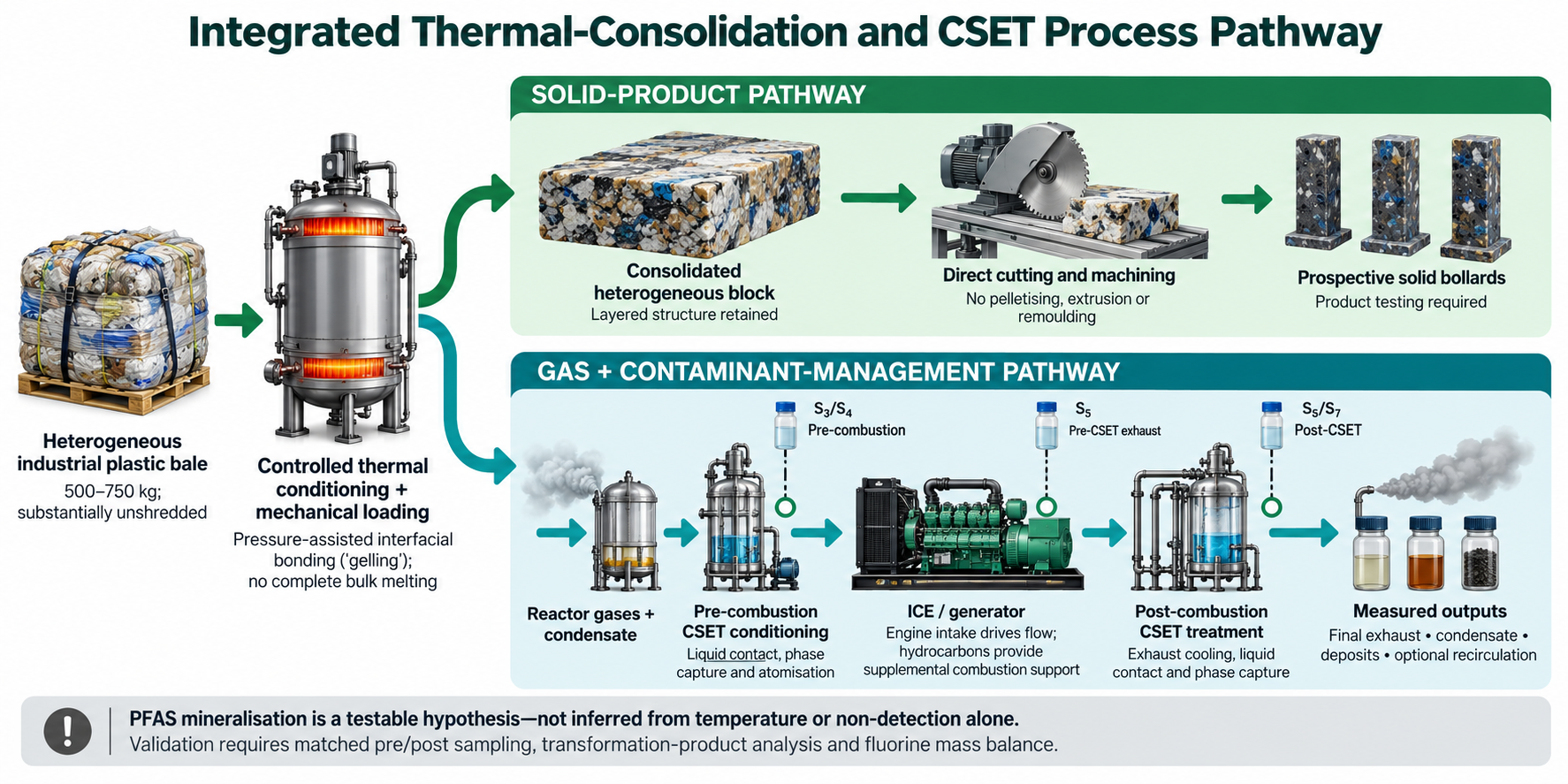
Figure 1. Integrated pathway for processing heterogeneous industrial plastic waste. Controlled thermal conditioning and mechanical loading produce a consolidated, macroscopically heterogeneous block for direct cutting and machining, while released gases and condensate are directed through pre-combustion CSET conditioning, the internal-combustion engine/generator and post-combustion CSET treatment. Sampling boundaries support separate accounting of solid, liquid and gaseous phases. PFAS mineralisation remains a testable hypothesis requiring matched pre- and post-treatment sampling, transformation-product analysis and fluorine mass balance.